
01
Drive
Builds and strengthens the leadership array, generates change-energy and uses it to power the mechanisms across the community's systems.
A community is a complex, abstract social concept, so it is often hard to understand how it works, why it grows stronger or weaker, and what it is missing. During a visit to a garage, watching a mechanic take a car apart into systems and parts in order to diagnose a fault, a question came to me: could a mechanical guide be created for a community too, one that would help understand how it works?
From that question I set out on a process of inquiry, from which the Community Mechanics approach took shape. Along the way I examined communities of many kinds - social, geographic, political, intra-organizational and product communities. By identifying recurring functions and patterns, I distilled seven core systems that exist, in different forms, in every community.
The approach breaks each system down into parts, mechanisms and upgrades, and examines how they act on one another across the stages of a community's life: formation, establishment, ongoing activity and renewal. This structure makes it possible to compare communities, to learn from successes and failures, and to adapt insights, work processes and technological tools from one community to another.
A community, like a machine, is powered by energy: the time, the capabilities and the resources that the community's organizers and members invest in order to change and shape its social structure. The Community Mechanics approach helps community organizers increase this change-energy, and know which community mechanisms to activate and when, in order to advance the community in the best and fastest way and achieve its goals.
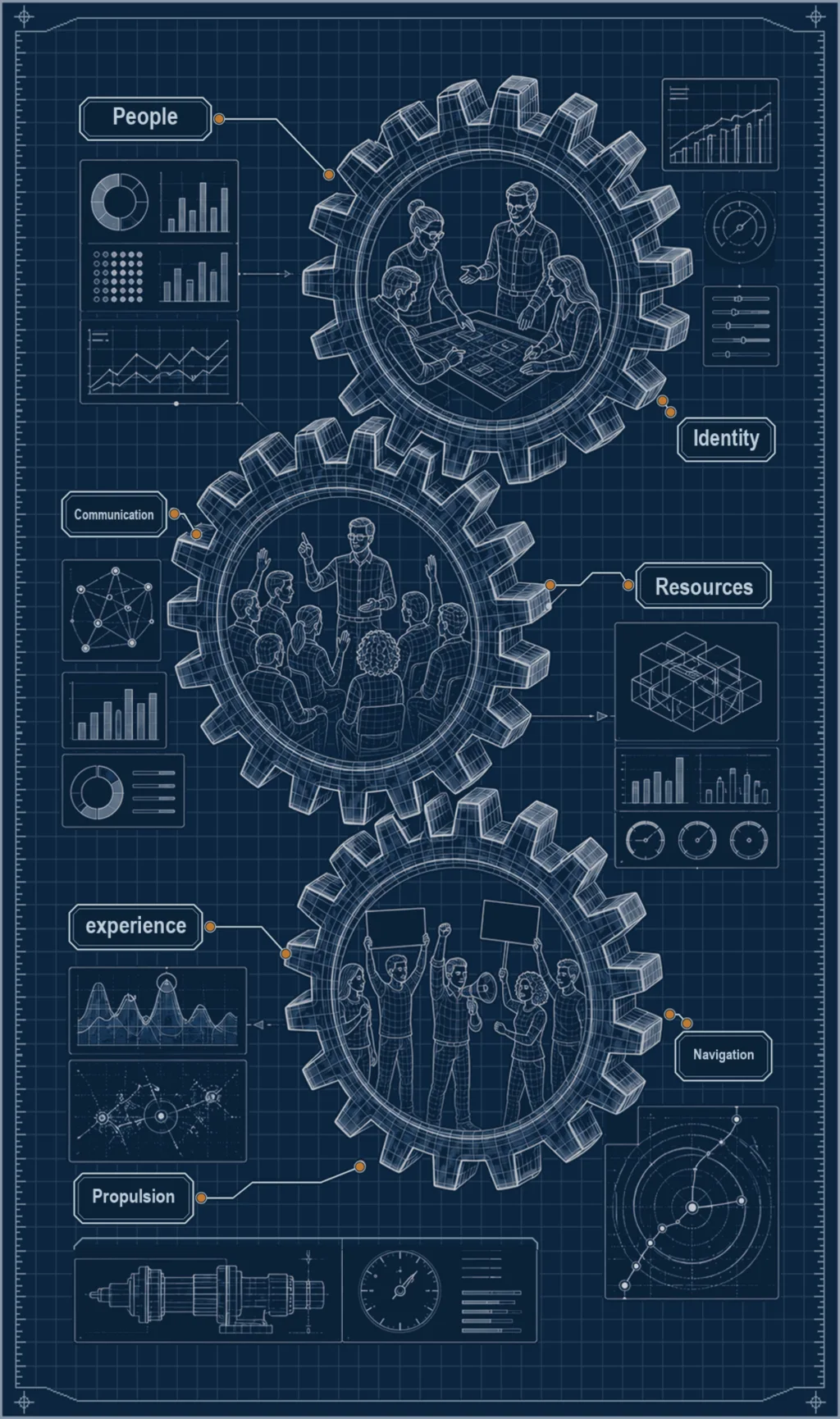
The community machine is made up of seven connected systems, each responsible for a different area of activity and each affecting how the others operate.
Builds and strengthens the leadership array, generates change-energy and uses it to power the mechanisms across the community's systems.
Defines the essence of the community through narrative, values and goals, and translates it into tangible expressions present in members' lives.

Collects and processes data into a situational picture, insights and action recommendations, and reflects them back to the leadership, members, partners and the public.
Creates and sustains physical, digital and hybrid circles of dialogue, enabling presence, sharing, the processing of experiences and ongoing interaction among members.
Manages the human journey in the community - from identifying and recruiting relevant people, through onboarding, strengthening ties and increasing involvement, to taking on responsibility and leadership.

Maps members' needs and the resources available to the community, and on that basis creates relevant value propositions and makes them accessible to members.
Plans and builds community happenings, such as content, gatherings and events, and weaves them into plans, series and processes as part of an annual activity plan.
The community's systems are made up of four core elements: parts, mechanisms, upgrades and change-energy.
The building blocks of the system - the components it rests on and that the mechanisms act upon. In diagnosing a community we check whether each part exists, and if so, how developed it is.
The system's action processes. They operate on its parts, changing and developing them or using them to produce community outputs. In diagnosing a community we examine whether they are working efficiently.
Methodologies and technological tools that improve how the mechanisms work and help them operate more efficiently, consistently and precisely. In diagnosing a community we examine whether there are upgrades that can be implemented.
The force that powers the mechanisms, generated by the time, capabilities and resources that the community's organizers and members invest in the community. In diagnosing a community we examine how much change-energy exists and which mechanisms it is right to invest it in.
Identifying the type of community and its stage of development, mapping the systems and locating strengths, challenges and barriers.
Selecting the methodologies and technological tools that can improve how the relevant mechanisms work.
Assessing the available change-energy, prioritizing actions accordingly, defining goals and success measures, and building a timeline.
Implementing the intervention process, tracking progress and making adjustments according to the results coming in from the field.
Reviewing performance against the success measures, checking how the changes have been embedded in the community, forming recommendations for what comes next and summarizing the process.
A community diagnosis helps build a situational picture, identify strengths and barriers, and understand where it makes sense to begin. You are welcome to run an initial diagnosis for your community.